






Racial Justice News
Contribute by publishing to the newswire or calendar and selecting the topic "Racial Justice"
 Upcoming Events |
 Photo Gallery |
Links
Photo Gallery |
Links
Upcoming Events |
Photo Gallery |
Links
Saturday Jun 13
Sunday Jun 14
Friday Jun 19
Wednesday Jun 24
[ × close ]

Thu Apr 30 2026 (Updated 05/04/26)
May Day 2026 Confronts War and Autocracy
Workers unite on May 1st every year. This year, the fight confronted the growing threat of autocracy and war. Protesters marched in San Francisco, San José, and Oakland. A number of contingents participated and staged separate actions, advocating for single-payer healthcare, queer & trans rights, and class war. Morning actions at the Oakland Airport and General Dynamics in Healdsburg focused on weapons given to Israel and the war on Iran.

Sun Apr 19 2026 (Updated 05/07/26)
Juristac is Protected
Peninsula Open Space Trust (POST) has purchased an additional 2,284 acres of the historic Sargent Ranch property, originally named Rancho Juristac. To date, POST has protected 6,114 acres of the 6,500-acre ranch that is home to multiple at-risk species and provides vital habitat and connectivity for wildlife across the region. This land forms the core of the Juristac Tribal Cultural Landscape, an area held sacred by the Amah Mutsun Tribal Band.
Tue Dec 23 2025
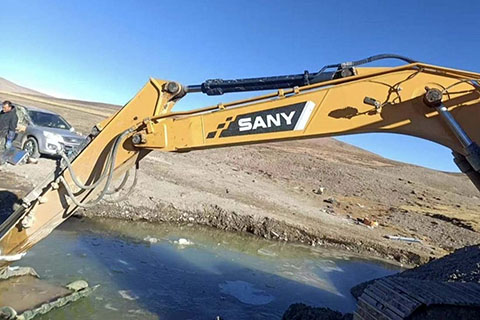
Bay Area Tibetans Protest Against Gold Mining in Kashi
On December 20, the San Francisco Regional Tibetan Youth Congress held a demonstration in front of the Chinese Consulate in San Francisco over illegal gold-mining operations in Sershul, Eastern Tibet, and the subsequent arrests of more than 80 innocent Tibetans in the region. According to reports, the gold-mining operations were being undertaken in Serkhok, a traditional grazing site in the region.
Tue Nov 25 2025 (Updated 12/03/25)
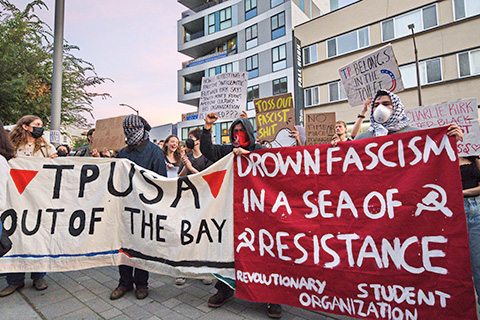
Undeterred, Hundreds Stand Against Turning Point in Berkeley
On September 10, Turning Point USA founder Charlie Kirk was fatally shot by a sniper while speaking in Utah. The event was the first stop of TPUSA's "American Comeback Tour." On November 10, Turning Point concluded their tour at UC Berkeley. The campus was locked down beforehand by a phalanx of riot police. Despite the show of force, hundreds of demonstrators turned out to denounce TPUSA. Several arrests were made.

Tue Nov 11 2025
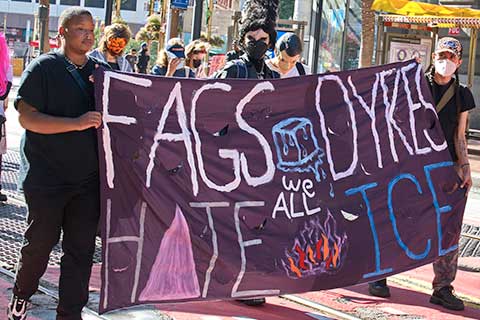
Trans and Queer People "Scare the State" on Halloween
On Halloween, San Francisco’s queer community marched down Market Street to the U.S. Immigration Court on Montgomery Street to counter tyranny with costumes and protest. The Halloween event first assembled at the Powell Street cable car turnaround, where banners were unfurled that read, "Queers for Open Borders" and "Fags, Dykes, We All Hate ICE." When the march arrived at the courthouse, the building was renamed the “ICE Abduction Center.”
Tue Nov 11 2025
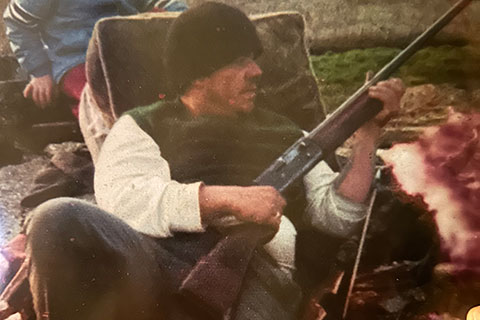
Events Honor 50th Anniversary of Wounded Lee
In February 1975, construction work on Lee Road in Watsonville desecrated an Ohlone burial site, and bones and artifacts were removed by archeologists. When initial efforts failed to protect the sacred site, the cemetery was occupied by a group of armed local Native families, activists, and members of the American Indian Movement. John Malkin speaks with Patrick Yana-Hea Orozco, who played a critical role in the direct action at Wounded Lee.


Wed Nov 5 2025
Pesticides Detected in 80% of State's Air Monitoring Samples
Pesticides continue to be pervasive in the air throughout California’s agricultural regions, according to the 2023 Air Monitoring Network Report released in September by the Department of Pesticide Regulation (DPR). Weekly samples collected at DPR’s four air monitors detected 19 different pesticides at trace or quantifiable levels and 8 pesticides at quantifiable levels, with 80% of samples including at least one pesticide detection.

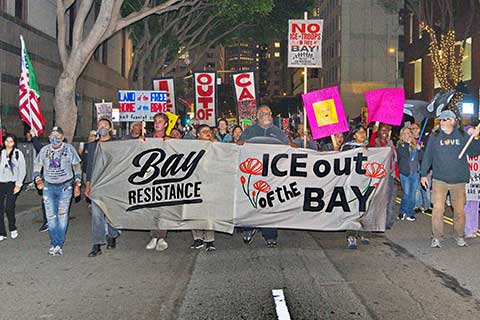
After days of Donald Trump threatening to deploy the National Guard to San Francisco, U.S. Customs and Border Protection (CBP) agents began massing at Coast Guard Island in Alameda on October 23. Residents across the Bay Area responded that same day by organizing emergency rallies. At Coast Guard Island, authorities used at least one flash bang grenade on demonstrators. Shortly after the confrontation, Trump walked back his troop threat.
Mon Oct 13 2025 (Updated 10/22/25)
Commemorating Two Years of Resistance
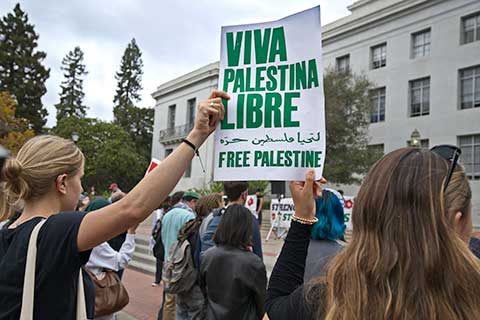
Events were organized across northern California to commemorate two years of resistance to the Israeli genocide in Gaza. Calls were widely made for an end to the forced starvation of the Gazan population, and for an end to U.S. military aid to Israel. In Oakland, community members marched to demand an arms embargo; at UC Berkeley, students organized a mass walkout; in Petaluma, activists conducted their long-time weekly picket.
Sun Oct 12 2025 (Updated 10/21/25)
UCSF: Reinstate Dr. Rupa Marya
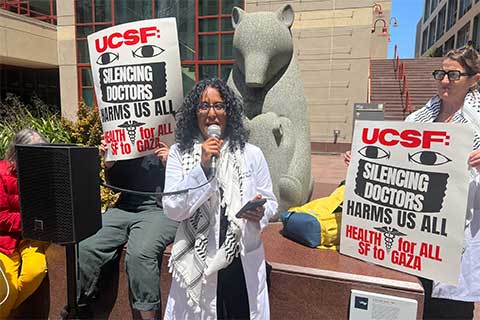
The SF Bay Area office of the Council on American-Islamic Relations is calling on the University of California, San Francisco to reinstate professor of medicine Dr. Rupa Marya and publicly affirm that it will safeguard academic freedom and free speech. Dr. Marya was terminated from UCSF in May 2025, which came after her medical privileges were suspended in September 2024 over social media posts in which she criticized Israel’s genocide in Gaza.

 From the
Calendar
From the
Calendar
We are 100% volunteer and depend on your participation to sustain our efforts!
Donate

$115.00 donated
in the past month
Get Involved
If you'd like to help with maintaining or developing the website, contact us.
Publish
Publish your stories and upcoming events on Indybay.
Topics
More
Search Indybay's Archives
Advanced Search
►
▼
IMC Network
Beyond the Food Desert: How East Bay Communities are Fighting for Food Access
Posted: Sat Jun 6th 6:53pm
Rally at SF City Hall, Bayview-Hunters Point Calls for Mass Mobilization Over Shipyard
Event: Wed Jun 24th 12pm
UAW Members Demand that UAW Rescind Endorsement of Zionist /Billionaire Shill Scott Wiener
(2 comments)
Posted: Tue Jun 2nd 7:11am
New CA water coalition releases 'Renaissance' water plan that rules out the Delta Tunnel
Posted: Mon May 25th 8:03am
Uncovering the Legacy of California Filipino Farmworkers with Dr. Robyn Magalit Rodriquez
Posted: Fri May 22nd 8:24am
 CCR Condemns New York Officials’ Support of Israeli War Criminals at Israel Day Parade
Posted: Tue Jun 2nd 2:06pm
Old Sacramento prepares for California 175 - State Capitol Juneteenth Dia de Los Negroes
Posted: Mon Jun 1st 6:12pm
1854 Historic Negro Bar, Sacramento County - Leidesdorff Plaza - Diamond Jubilee
Posted: Fri May 29th 2:04pm
Barcelona: Amazon factura millones y regatea céntimos a quienes trabajan…
Posted: Mon May 25th 9:43am
México Conferencia con referente Moira Millán sobre su libro «Terricidio"
Posted: Tue May 5th 12:06am
Planning for Honorable William Alexander Leidesdorff, Jr. Memorial Wreath Laying Ceremony
Posted: Tue Apr 28th 9:15pm
Leidesdorff Plaza - Diamond Jubilee rekindles the “Continuum” of California 175
Posted: Sun Apr 26th 4:16am
Preserving California Heritage Negro Bar, Mormon Island and Negro Hill Mining District
Posted: Fri Apr 24th 1:38pm
California Juneteenth remains a quasi-optional holiday for a majority of State Employees
Posted: Wed Apr 15th 4:10pm
Discover the legacy of Alexander Leidesdorff Jr. Memorial Highway along US 50
Posted: Sun Apr 12th 1:27pm
America 250, 2026 National Ag Day - Nancy and Peter Gouch - California Agricultural Legacy
Posted: Sun Mar 15th 4:14am
Should California Juneteenth and Mexican Juneteenth be official paid holidays?
Posted: Mon Mar 9th 2:53pm
CCR Condemns New York Officials’ Support of Israeli War Criminals at Israel Day Parade
Posted: Tue Jun 2nd 2:06pm
Old Sacramento prepares for California 175 - State Capitol Juneteenth Dia de Los Negroes
Posted: Mon Jun 1st 6:12pm
1854 Historic Negro Bar, Sacramento County - Leidesdorff Plaza - Diamond Jubilee
Posted: Fri May 29th 2:04pm
Barcelona: Amazon factura millones y regatea céntimos a quienes trabajan…
Posted: Mon May 25th 9:43am
México Conferencia con referente Moira Millán sobre su libro «Terricidio"
Posted: Tue May 5th 12:06am
Planning for Honorable William Alexander Leidesdorff, Jr. Memorial Wreath Laying Ceremony
Posted: Tue Apr 28th 9:15pm
Leidesdorff Plaza - Diamond Jubilee rekindles the “Continuum” of California 175
Posted: Sun Apr 26th 4:16am
Preserving California Heritage Negro Bar, Mormon Island and Negro Hill Mining District
Posted: Fri Apr 24th 1:38pm
California Juneteenth remains a quasi-optional holiday for a majority of State Employees
Posted: Wed Apr 15th 4:10pm
Discover the legacy of Alexander Leidesdorff Jr. Memorial Highway along US 50
Posted: Sun Apr 12th 1:27pm
America 250, 2026 National Ag Day - Nancy and Peter Gouch - California Agricultural Legacy
Posted: Sun Mar 15th 4:14am
Should California Juneteenth and Mexican Juneteenth be official paid holidays?
Posted: Mon Mar 9th 2:53pm
[ × close ]